Breakfast at Veronica and Tom's B&B consists of crepes suzette, which was absolutely delicious, but a little too sugary for first thing in the morning. Our plan for the day was to take a 30-mile circular drive around the Dingle Peninsula. We got an early start to beat the tourists. We had perfect weather--warm and breezy and sunny.
The scenery everywhere you go in the Dingle Peninsula is astounding--it was hard not to spend the entire day spinning in circles taking panoramic photographs. After a brief stop to look at the scenery at Ventry Beach, we stopped at the small Celtic and Prehistoric Musuem in the little town of Ventry. The museum is a little overpriced, but very interesting. The owner, a good-humoured American, gave us a guide book to show us through the museum, full of good information and relevant Far Side cartoons. The museum is home to Millie, and most complete extant woolly mammoth skull (which some fisherman found in his net--that must have been a surprise!). The skull and its tusks are as tall as the room they're in--a good 8 feet or so. That was an impressive site. The rest of the museum contains lots of nifty prehistoric artifacts from the Stone Age up through the La Tene Celtic period.
Driving the Dingle Peninsula got pretty silly. There are lots of really sharp curves in the narrow roads. The peninsula is full of oblivious sheep--we came across two who were just standing in the road, chewing their cud and staring at the cars that had to veer around them. We never got to go very far at once--there is a site worth stopping for about every half mile. For instance, a half mile after the Celtic and Prehistoric Museum, stopped to look at an ancient ring fort--it's a small one, with two circular earth mounds, in a cow pasture.
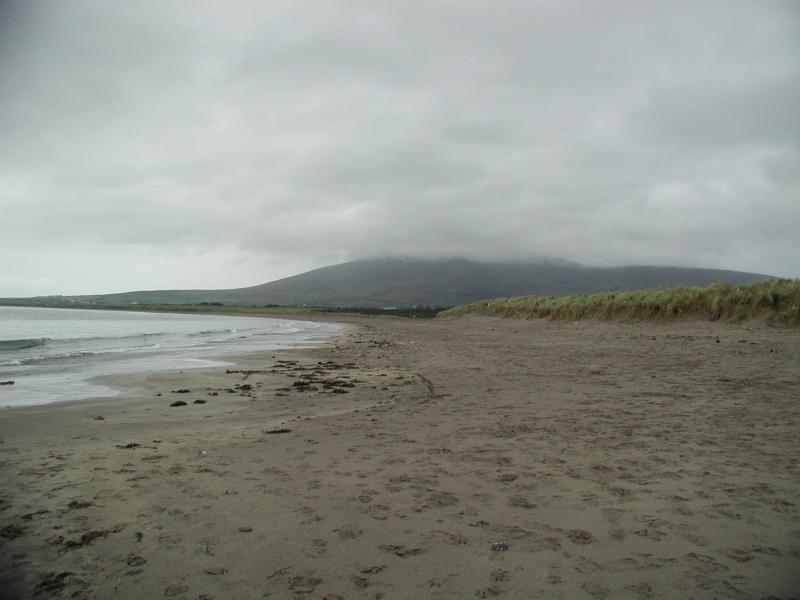 Ventry Beach
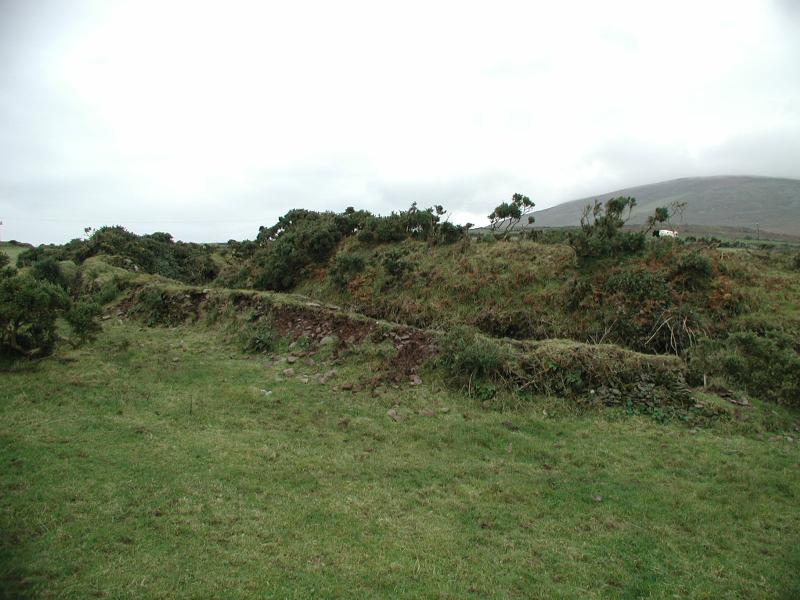 Hill fort in a cow pasture
A half mile later is Dunbeg Fort, a large Iron Age hill fort which is gradually falling off the edge of the cliff where it perches. It has a few earth ramparts and a stone wall and remnants of a stone beehive hut. It was neat being in a place that has been inhabited by humans for so long, wondering what kind of battles were won and lost here, and admiring the same view of cliffs and pastures that must have attracted the original builders to the site.
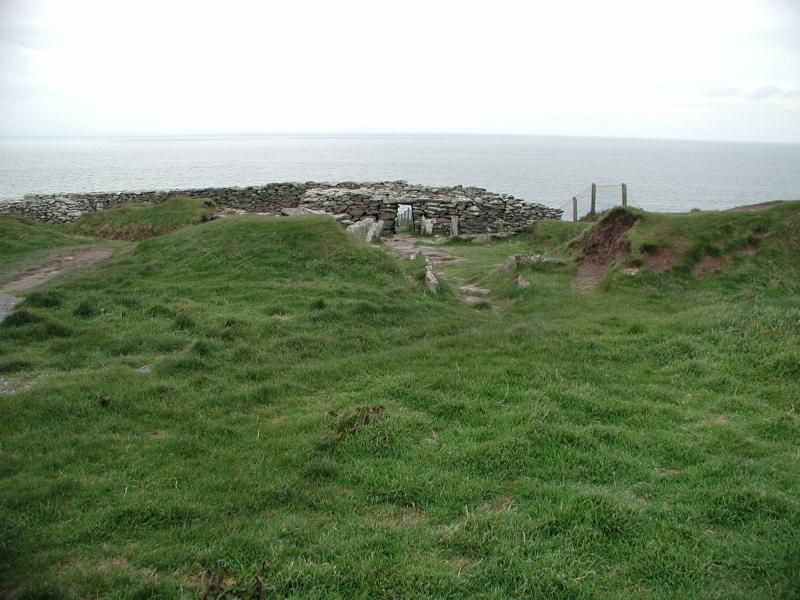 Dunbeg Fort
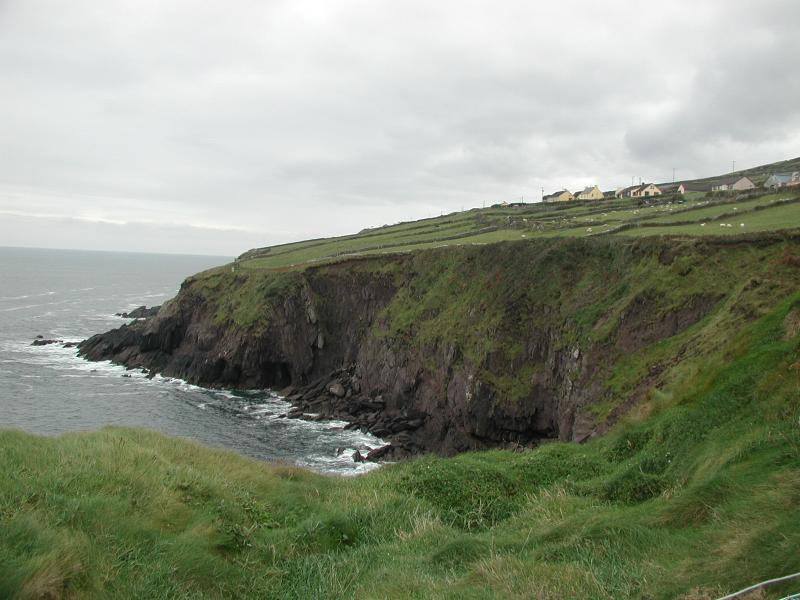 The view from the fort
Another half mile down the road we stopped to look at a little cluster of clochans, or corbelled beehive huts. One of them is still complete--the others are missing their upper walls and roofs. They are tiny little houses, but seem like they would be cozy and comfortable. They are made without mortar--just beehive shaped piles of rock--but the stones are fitted together very skillfully.
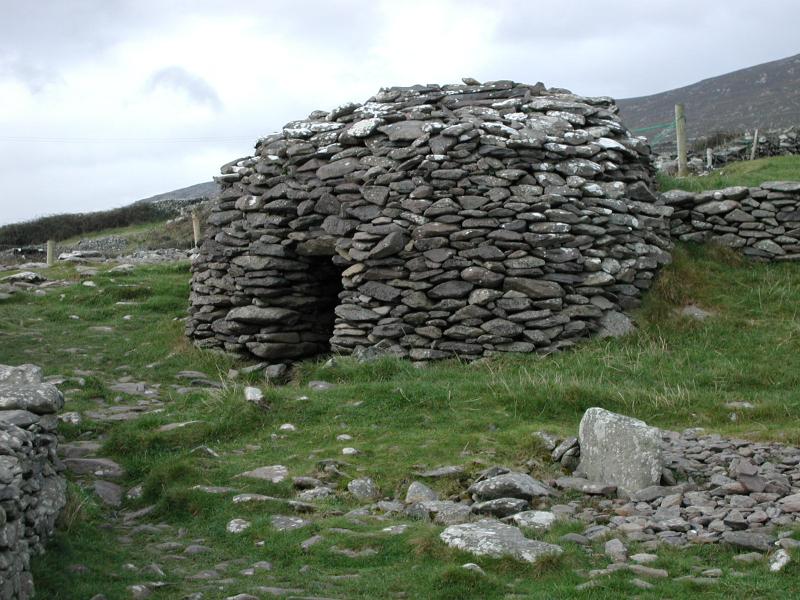 A beehive hut
We took a turn off the beaten path and ended up going down a very steep twisty road. When the road got really rough, we parked Augusta and walked the rest of the way down the road to a wonderful little beach. The beach is a small haven of smooth sand nestled between the rocky cliffs. The breeze coming off the water felt warm and fresh, and we watched the waves of the incoming tide crest and roll over the beach, wiping the sand smooth with every stroke.
We soon reached Slea Head, a little scenic overlook at the tip of the peninsula with remarkable views of the Blasket Islands. This is the westernmost point of Europe, and the scenery was gorgeous. The tip of the peninsula is interesting, because farmers have had to make the land here arable by mixing seaweed and sand with the existing clay soil. The Dingle Peninsula used to have five times more people on it than it does now, but after the Potato Famine, the population has never reached its former levels. There are many fields that used to be farmed before the Famine that are now bare.
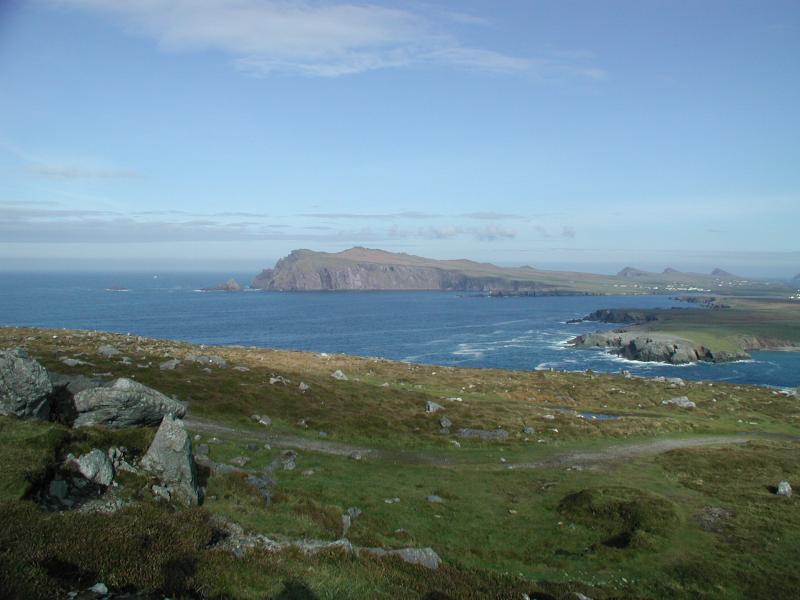 This is the westernmost point of Europe. Later in the day we climbed out
onto the rocks in the middle of the picture. The distant hills on the
right side of the picture are known as the Three Sisters.
This is the westernmost point of Europe. Later in the day we climbed out
onto the rocks in the middle of the picture. The distant hills on the
right side of the picture are known as the Three Sisters.
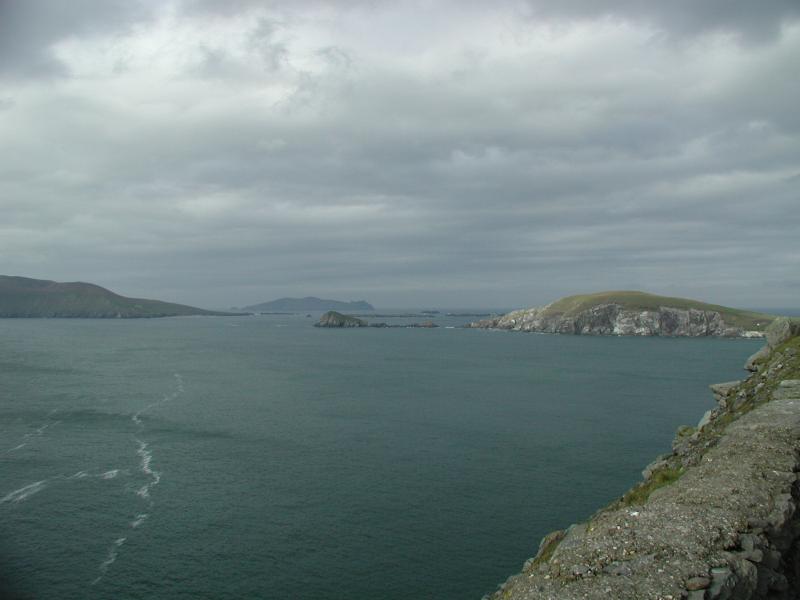 The Blasket Islands
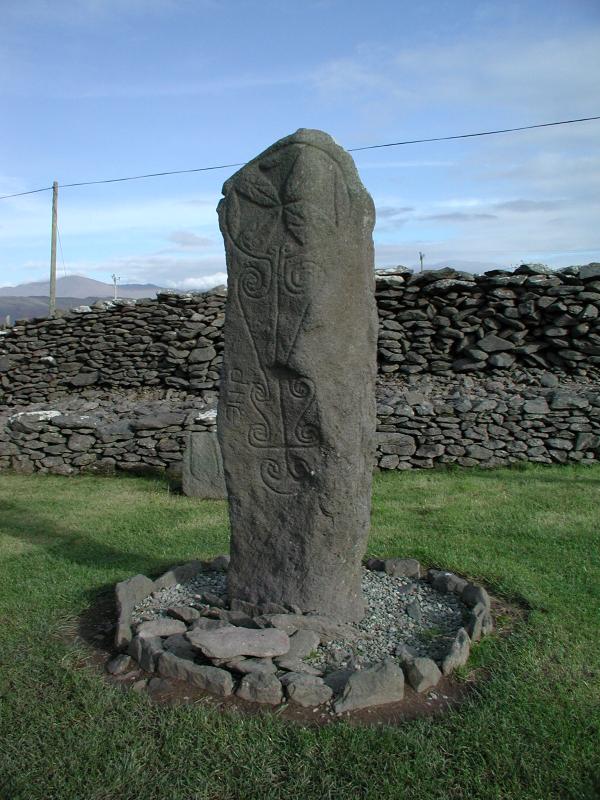
Another detour off the main road took us to the Reasc Monastery, a teeny tiny cluster of stone buildings used from the 6th to the 12th centuries. All that remains now are stone walls 2-3 feet high, but you can see where the little beehive huts used to be, and the wall that divides the working area from the praying area. There is also an underground kiln here, and an ancient rock with Celtic carving on it, to which the monks later added a cross.
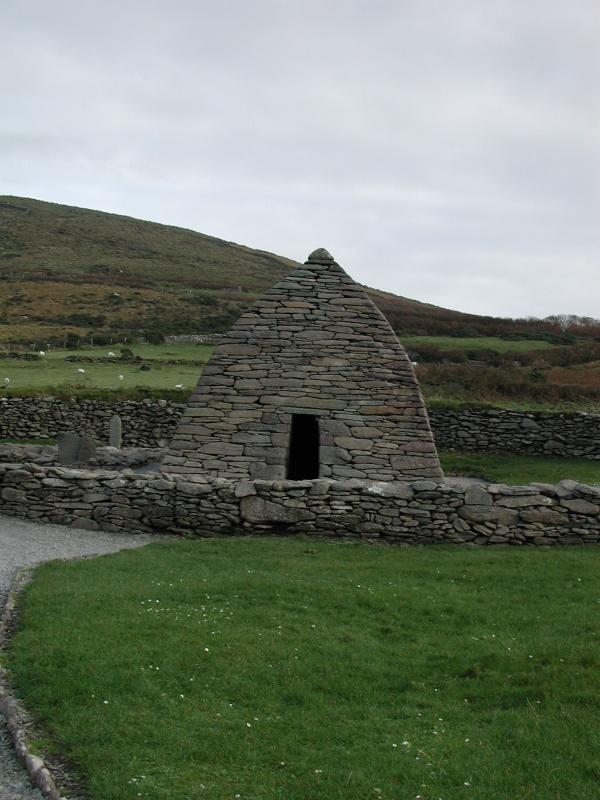
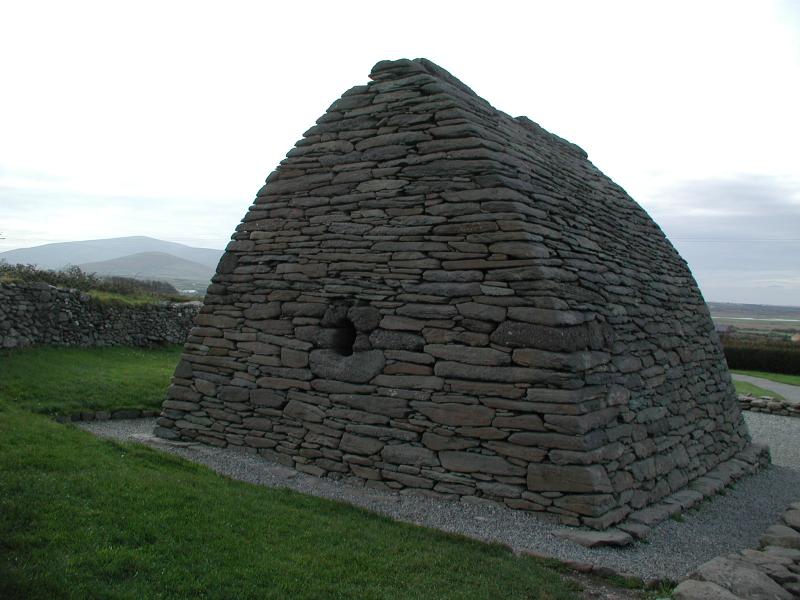
That little monastery was a good warm-up for our next stop, the Gallarus Oratory. This is an amazing little stone building, one of Ireland's oldest Christian buildings. It is corbelled, made entirely without mortar. All the stones are still in place, and for 1,300 years, this little building has been a watertight testament to some monk's ingenuity. It has a neat little window inside.
At the head of the path to the oratory, there was a sign about a bunch of other nearby sites, and the sign made it sound like all the sites were within close walking distance. There was a trail nearby, marked with a picture of a monk on a pilgrimage, so we decided to follow this trail and see if it took us to the other sites. The pilgrim signposts led us across pastures, over stiles, through streams, and into ever more remote areas. We followed it for a while, mooing at cows and baaing at sheep, but we eventually decided that the path wasn't going to take us anywhere interesting any time soon, so we turned back.
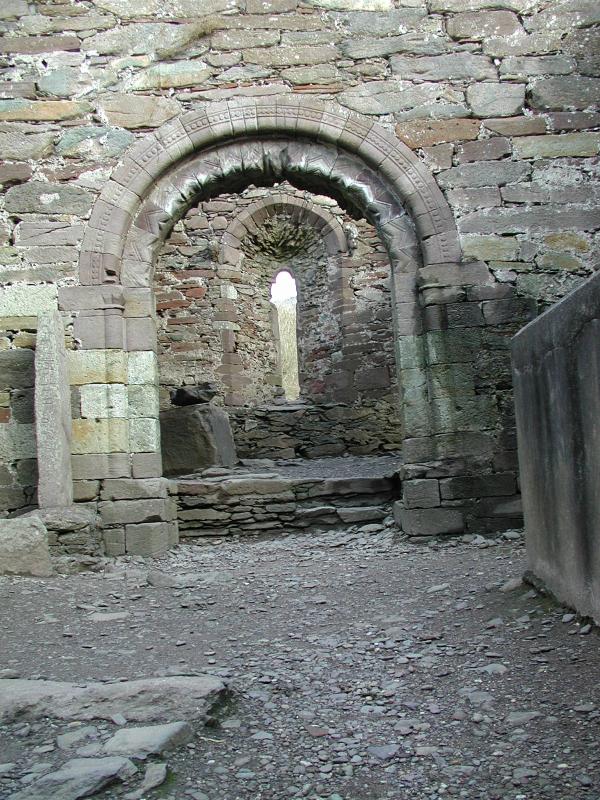
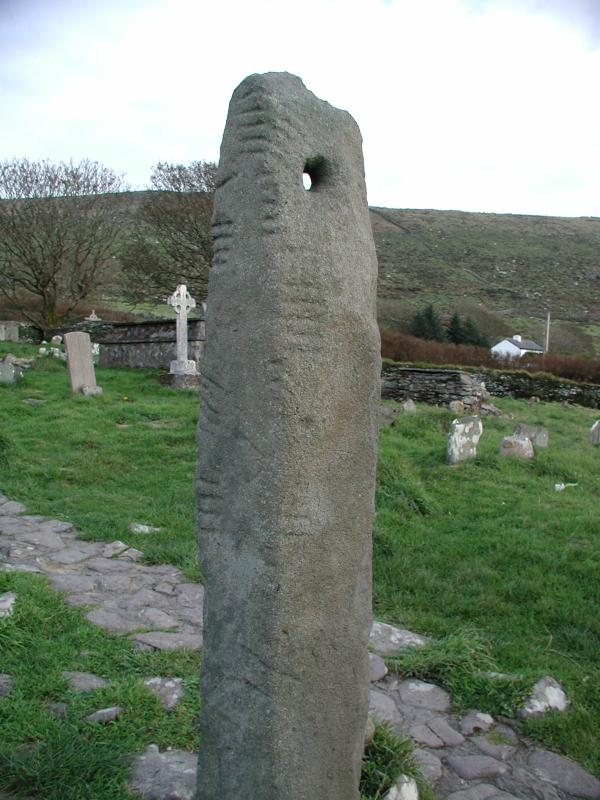
The road soon took us to some of the sites we had hoped the trail would lead us to. We stopped at the ruined Kilmalkedar Church. It was built in the 12th century, and has Romanesque decorative carving around the doorways. A graveyard surrounds the church, which has been used since the church was built--many of the graves are very recent (past 10 years). This has been a holy site for many centuries--a pre-Christian ogham stone stands in front of the church (ogham is an ancient Irish alphabet, often used for sacred writing). The stone has a hole carved through it--you stick your finger in the hole to make a binding oath.
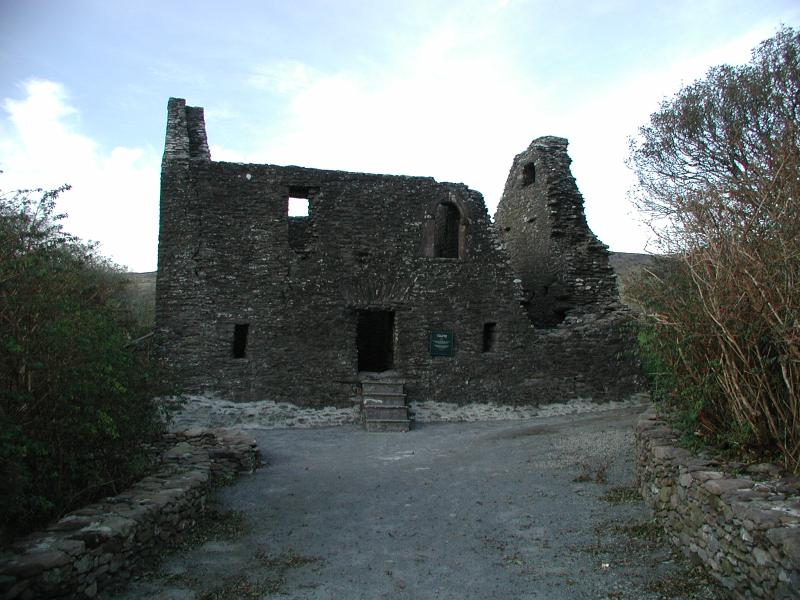
Near the church is a Medieval two-story house, where St. Brendan supposedly lived for a while. The house is remarkably intact, for being so old. It was pretty big too, especially compared to all the tiny beehive huts we've seen.
By this time, we were really pooped and had seen all of the major sites that we had planned to see. So we returned exhausted to Dingle and went for another shopping trip to finish buying gifts for family members and CDs and books for ourselves. The shops in Dingle are much less touristy than the shops everywhere else we had been. There are a lot of local artists, so you can buy lots of nice crafts. We also had a yummy pub dinner, then stopped by to say a short hello to Tom and Veronica, and took a nap so that we would be refreshed for another night of pubs.
Some places have traditional dancing lessons on Wednesday nights, but we had slept too late to join them, so we went into a pub for a drink. We talked to the locals there, but we ended up in the wrong group of locals--one guy in particular who wanted to talk to us a lot was the epitome of a lost soul. He would watch us expectantly with large empty eyes, spoke very sadly of his life, and made both of us feel really creepy. He had a friend who was drowning his sorrows--it was the first time we had seen an Irishman unable to hold his liquor. So feeling the weight of their world upon our shoulders, we downed our drinks quickly and left the pub. (One thing we noticed about Ireland is a deep sense of tragedy--all of Ireland's history has been one tragic invasion after another, the people who call this place home constantly fighting to keep their homes and their precious culture--you can hear this tragedy in their music and their stories, and I think at times it must really weigh down the population.) We were hoping a little walk around town would cheer us up, but a little cat started following us, meowing for attention, and he was too dumb to get out of the road when a car went by. He came within mere inches of getting killed, but fortunately wasn't hit. So, feeling even more freaked and sad, we decided the smartest thing to do was to return to something familiar, so we went back to the Small Bridge. The music was already underway, and the crowd was lively. We didn't sit quite so close to the musicians this time.
The Small Bridge did redeem our evening somewhat. Again, there was good atmosphere, good drink, good music, and good company. The company consisted of a little group of Irish artists--two fiddlers, a potter, and a writer (one of the fiddlers is actually an American who has lived in Ireland for a long time). They were really nice to talk to, although two of them were talking about the time they encountered the Devil incarnate--a 6-foot, one-eyed, blue-eyed Rastafarian, who apparently did a lot of weird voodoo magic on them and then tried to kill them. So those stories didn't exactly help our mood when it was time to leave. We found our way back to the B&B as quickly as possible, watched some benign TV, ate some chocolate (chocolate makes everything better), and went to bed after an exhausting but overall wonderful day. Dingle was definitely our favorite place on the whole trip--with the beautiful scenery, the profusion of ancient sites, and the richness of the land, I can see why the population of Dingle Town is growing as fast as it is.
There's not much to report about our last day in Ireland--we had a three hour drive from Dingle to Shannon. It started on the Connor Pass, a road that takes you over the mountains of the Dingle Peninsula. The scenery was awe-inspiring. Other than that, the drive was quick and uneventful, and we sadly left this beautiful land to come home and dream of returning.
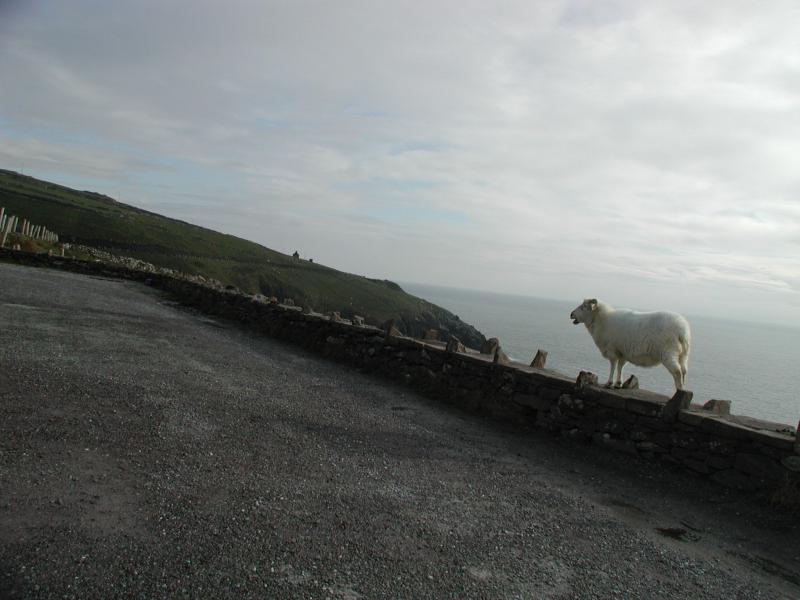 Sheep don't seem to mind the edges of cliffs. Or cars. Or anything else,
for that matter.
Sheep don't seem to mind the edges of cliffs. Or cars. Or anything else,
for that matter.