On Sunday, we packed our stuff, said a fond goodbye to our hosts, and headed back into Dublin. The storm the night before had knocked lots of trees down, so we had to take a different road to get to Dublin.
We started the day at Kilmainham Gaol, which is a long way from the City Centre. Had we realized quite how far it was, we would have taken a bus, but all we had were large bills fresh from the ATM, so we walked instead. After lots of walking into the ferocious wind, we finally arrived at Kilmainham Gaol (which is just a silly way of spelling jail). We had to wait to take our tour, but while we waited we had time to look at an exhibit about Victorian prisons. Prisons in the 1800s had two major premises--observation and labor. They believed they could reform people by watching them all the time and by forcing idleness out of them. So while prisoners were in their rooms, guards were constantly watching them through peep-holes. And when they weren't in their rooms, they were forced to do meaningless labor, like breaking stones and moving cannonballs from one pile to another.
The tour soon started, and we were taken into the prison's chapel to watch a slide show about the history of the gaol. It was hard to pay attention to the show because some guys had brought two boys with them who couldn't have been more than 4 or 5 years old, and the boys were really restless and noisy--we couldn't hear the audio over them at times. The slide show was more about the history of Irish Rebellions from 1790 (when the gaol was first built) onward than about the gaol itself, but the gaol housed political prisoners during these rebellions. All of the men and women imprisoned and executed for the Easter Rebellion and the Civil War were in Kilmainham Gaol (in fact, two of the prisoners were married in the chapel where we watched the slide show, the night before the groom was exectued). The Gaol hasn't been used since the Civil War.
After the slide show, we walked through the prison and saw the cells, which aren't much smaller than a lot of dorm rooms at Oberlin. Then we saw the prison yards where the political prisoners were executed. Finally, we saw the Victorian Wing of the prison, built in 1862, which had a glass ceiling to let in lots of light, since the Victorians believed the prisoners needed light for spiritual reformation. It was interesting learning many of the details of the events leading up to the Civil War, and quite chilling to stand in a place where men had given their lives for their country's freedom.
After the tour, we caught a bus back to the City Centre, where we visited the National Museum of History and Archaeology. The museum is free, and has exhibits about Prehistoric Irish Artifacts, Irish Treasures, Viking Influence, Medieval Ireland, the Fight for Irish Independence, and Ancient Egypt ("One of these things is not like the others, one of these things is not the same").
The Prehistoric exhibit was really neat. As we wandered, we could see how people's skill and technology advanced from the Stone Age to the Bronze Age. The ingenuity of these ancient people is astounding. We saw different types of burials, different kinds of tools and weapons, and the development of decoration. There was an entire section devoted to gold ornaments, which was really neat--skillfully twisted torcs, flattened lunular jewelry, and lots of bracelets, all very sparkly and intricate.
The next room we went to contained Ireland's archaological treasures. There was lots of nifty La Tene period art, and lots of beautiful brooches, crosses, and croziers. The highlights, though, were the Ardagh Chalice and the Tara Brooch. It was really neat to see in person two of the most famous pieces of Celtic art. The Tara Brooch is especially amazing--unbelievably tiny intricate detail.
We had a bit of a misadventure in the Treasure Room. This was the day that Daylight Savings time ended. Just as we were entering the room, the loudspeaker announced that the museum was closing in five minutes. Everyone in the room let out a gasp of panic, and the guards reassured us that we did still have another hour--they just hadn't adjusted all the clocks yet. Five minutes later, when the loudspeaker announced that, "This museum is now closed," we just chuckled and kept browsing.
Next we found our way to the Viking Exhibit. This focused on Viking activities in Dublin. It's pretty neat that the streets in Dublin today are there because Vikings walked there in the 9th century.
By this time, we were really tired, and it really was getting close to closing time, so we breezed through the Medieval and Egyptian exhibits, which were interesting but nothing amazing, and then went into the room about the Irish Fight for Freedom. The objects here weren't very interesting--mostly guns and uniforms--but reading the text panels reinforced a lot of what we had just learned at Kilmainham Gaol.
After a refreshing meal at a Japanese restaurant, we hopped back into the car and managed to maneuver our way all the way through Dublin and out the south toward the Wicklow Mountains. Maneuvering in Dublin is really tricky, because none of the streets go in a straight line for very long, and the streets change names just about every block, so telling someone to turn onto St. Patrick's Street really doesn't do any good.
Almost as soon as we left the city, we began going up. At times the road was really steep, but Augusta's little engine managed to pull us up. We paused near the top of the mountain to look back on the sprawling lights of Dublin, then continued our drive through the Wicklow Mountains. It was a wonderful drive--it's too bad we had to do it in total darkness. The roads were very narrow, windy, and bumpy. Next to the road was either conifer forest or pasture. We saw almost no signs of humanity for most of the drive--we passed hardly any cars, very few homes, and saw only an occasional fence. We did see some sheep--a pair of them were sleeping all cuddled together in the road--and a few very tiny deer. The drive wasn't very long, but took a very long time because we couldn't go more than about 30 mph. It was beautiful isolation, and amazing to be so far removed from humanity just a few miles away from Ireland's biggest city.
We reached our destination of Glendalough around 9:00. The town was very quiet and dead, continuing the feeling of isolation we had had on our drive. We stopped at a phone booth to call our B&B for directions, and she told us she didn't have any power because of the storms the night before. As we looked around the little town, we realized it wasn't isolated and sleepy, it just didn't have any power.
So that night we got ready for bed by candlelight, but not before stepping outside into the total darkness to admire the multitude of stars. That night we got the best night of sleep of the whole trip.
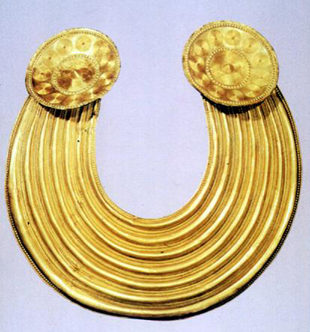 This is a lunular gold necklace.
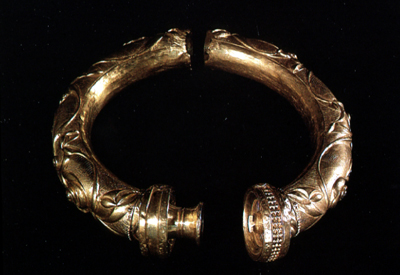 The almost-anthropomorphic swirly designs on this bracelet are typical of
La Tene period art.
The almost-anthropomorphic swirly designs on this bracelet are typical of
La Tene period art.
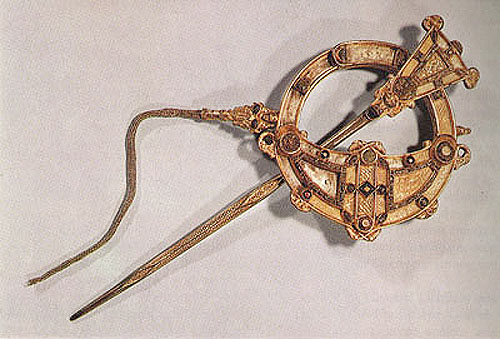 This is the Tara Brooch--a photograph will never do it justice.
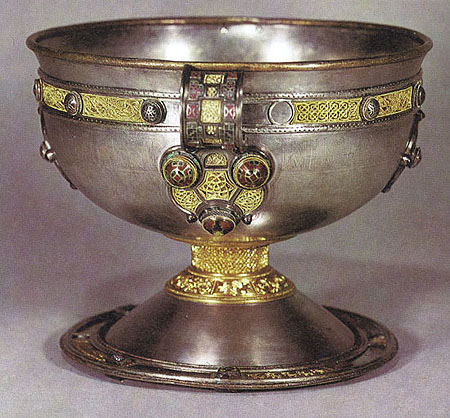 The Ardagh Chalice.