We had a lovely breakfast on our third morning in Ireland--we ate with a retired couple from Indianapolis, which was pretty silly. During breakfast, a tiny but ferocious storm popped up, heralded by a gorgeous double rainbow. Our poor hostess had to take her daughter to school during the 15 minutes that it was raining and hailing. By the time we were done with breakfast, the sky had cleared off and the sun was shining.
We left the west coast to head for Dublin on the east coast. As we drove, the countryside became greener, less rocky, and more full of sheep and cows and hedgerows. We followed the N6--although it's the major highway connecting Galway and Dublin, it's still just a two-lane road.
Before going into Dublin, we made a stop just north of Dublin in the Boinne Valley, which is full of prehistoric burial chambers and other nifty things. Finding the Bru na Boinne Visitors' Center, from which you catch a bus to explore these burial chambers, was kindof tricky, but we found it, and arrived around noon. We got there just before our bus left for Knowth, one of the burial sites, so we didn't have time to go to the bathroom or get a snack or call and arrange for tonights B&B or anything--we just had time to trot out to where the buses park and head for Knowth, which was about a 10-minute ride.
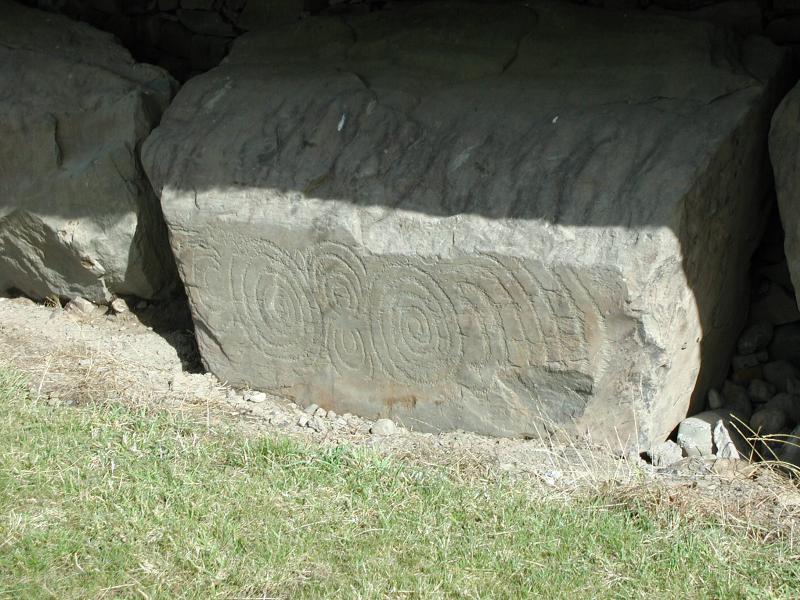
A guide met our group when we arrived, and led us to the passage tombs at Knowth. These tombs consist of large mounds of layered rock and dirt, with grass growing on top. Inside the mounds are passages that lead to burial chambers. Archaeologists found cremated remains and a few grave-goods inside the chambers. The Boinne Valley is riddled with these tumulus mounds--there are around 40 of them. There is a clump of 17 at Knowth. They were built in the Neolithic Era, about 5,000 years ago. At Knowth, the mounds were later used as mottes--first by prehistoric peoples who also dug tunnels into the mounds for storage and/or hiding places, and later by the Normans. Each tumulus has a ring of rock around the edge, and a lot of the rocks were carved with spiral and squiggle designs. After telling us about the site, the guide let us wander on our own for a while, pondering the thousands of feet that have trod on these mounds over the centuries.
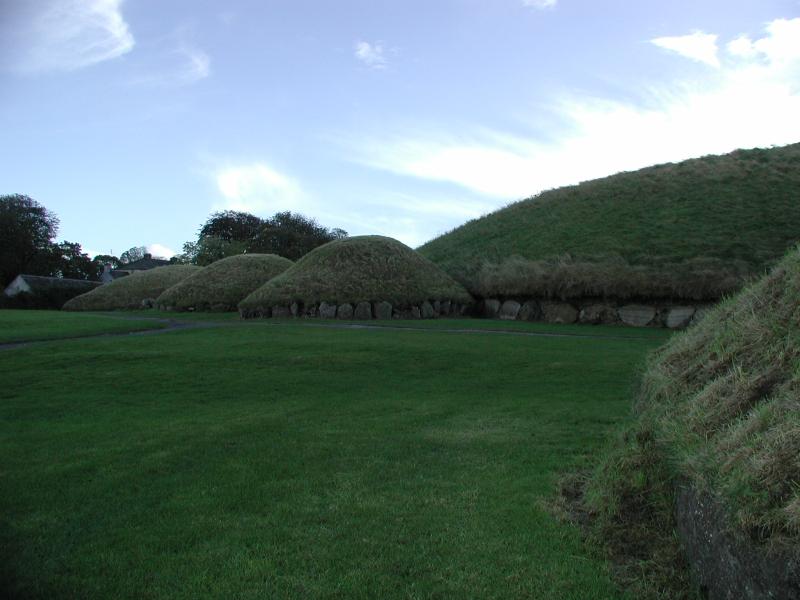
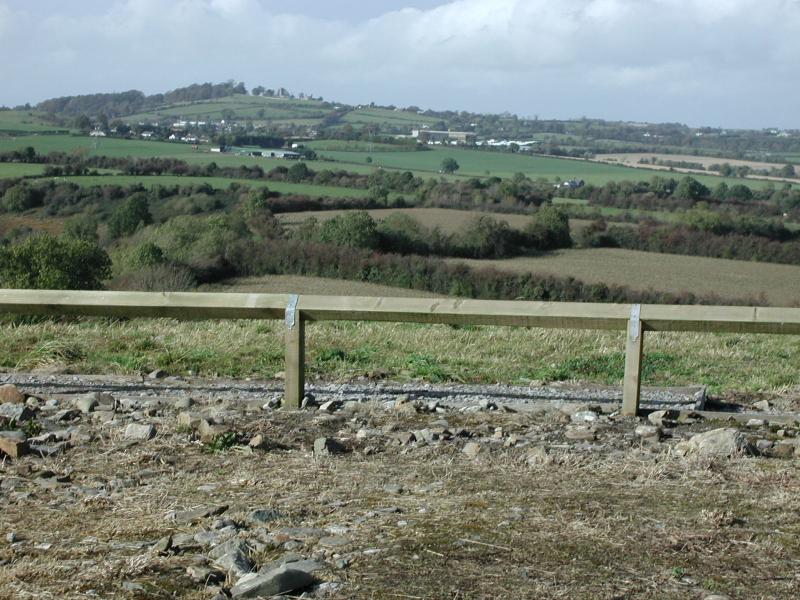 The view from the top of the biggest tumulus.
The bus came and took us back to the Visitors' Centre, but we didn't have time to go inside because we needed to take the next bus to Newgrange. Again, a guide met us once we arrived. As we pulled up to the site, a rainbow stretched over the Newgrange tumulus. The wind was picking up, and dark clouds were rapidly approaching. Jonathan and I had left our raincoats in the car, because we hadn't seen a hint of rain since breakfast. We won't make that mistake again--in the mere 15 minutes that we had to spend outside (we couldn't go into the tomb because another group was in there), it rained and the wind blew ferociously, so we were all wet and shivering by the time we got to go into the tomb. When we were outside the tomb, I was too cold to care about taking pictures, and when we were inside, it was too cramped to be able to get a picture of anything, so I didn't really get any good pictures here.
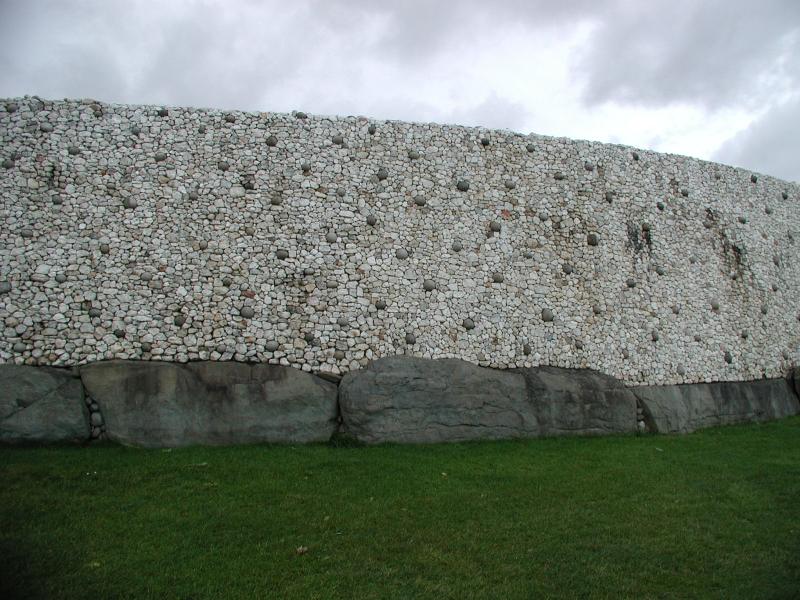
It was worth the cold and wet to see Newgrange though. Like Knowth, Newgrange was built around 3,000 BC--500 years before the pyramids at Giza. It is another carefully layered pile of rock and dirt, and it is amazingly stable--the corbelled ceiling supporting a 5-ton capstone has never collapsed. It is designed to be waterproof--grooves in the rock take water that soaks through the soil right off the mound. The front half of the mound is covered in a decorative pattern of quartz and water-shaped granite--both types of rock had to be brought from over 50 miles away in opposite directions. The decorative quartz and granite had all fallen off by the time the tomb was discovered, but it has been put back on since then. To make sure they were putting it back on right, the archaeologists reconstructed the pattern in the stone, then let it fall down again to make sure it fell the same way they had found it.
The opening of the tomb faces southeast, and is aligned just right that on the dawn of the Winter Solstice, a shaft of sunlight shines into the tomb and lights up the burial chamber. When we went into the tomb, the guide demonstrated what it is like being in there without any artificial light (it was pretty much dark), and what happens when light shines in--the whole cavern lights up for a few brief minutes. It must be a truly awesome experience to see it really happening.
Inside the tomb are three little chambers, each of which contained a stone basin and some human ashes. They don't know who the ashes were, or even the ritual significance of the tomb, but the experience of being in there and seeing the light of the Solstice is so primally moving that you don't need to know the exact significance to understand its power and meaning.
By the time we left the tomb, the rain had stopped, but the wind was still pretty fierce, so we were happy when the bus arrived and took us back to the Visitor's Centre. It was mid-afternoon, and we hadn't eaten since breakfast, so we went to the little cafe in there and had tea and scones with an English girl we had met on our tour named Claire. We had a good time talking with her. Then we briefly toured the exhibits in the Visitors' Centre, and I finally got in touch with a B&B near Dublin in a town called Ratoath.
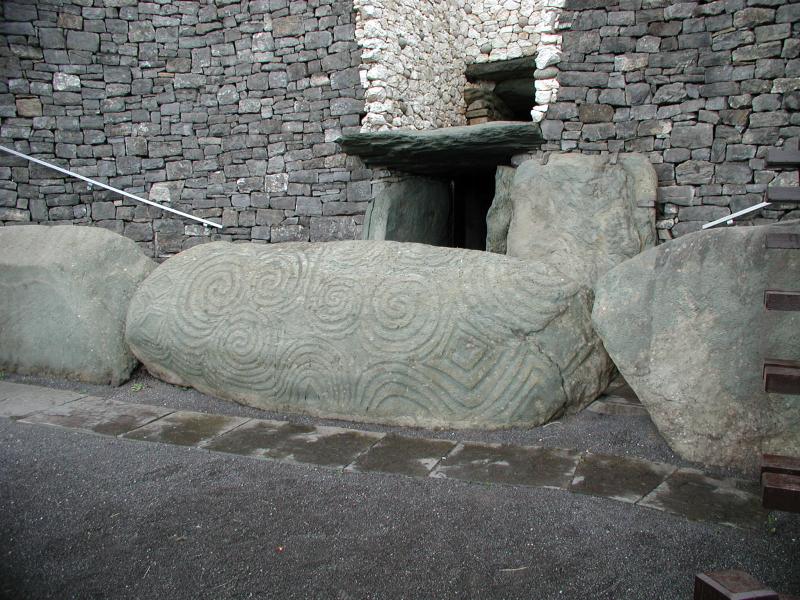 This large rock, which is carved with the finest surviving example of
stone-age art, guards the entrance to the tomb.
This large rock, which is carved with the finest surviving example of
stone-age art, guards the entrance to the tomb.
 This is the decorative pattern in the rock.
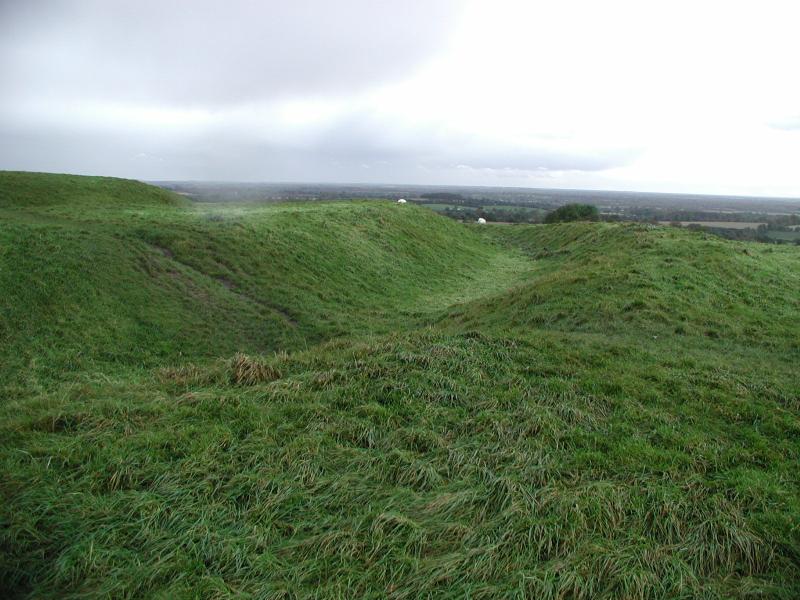
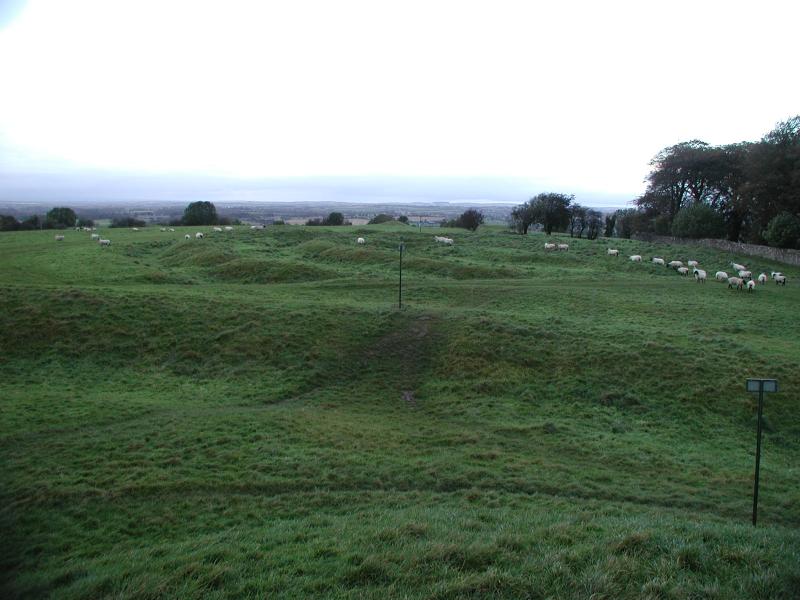
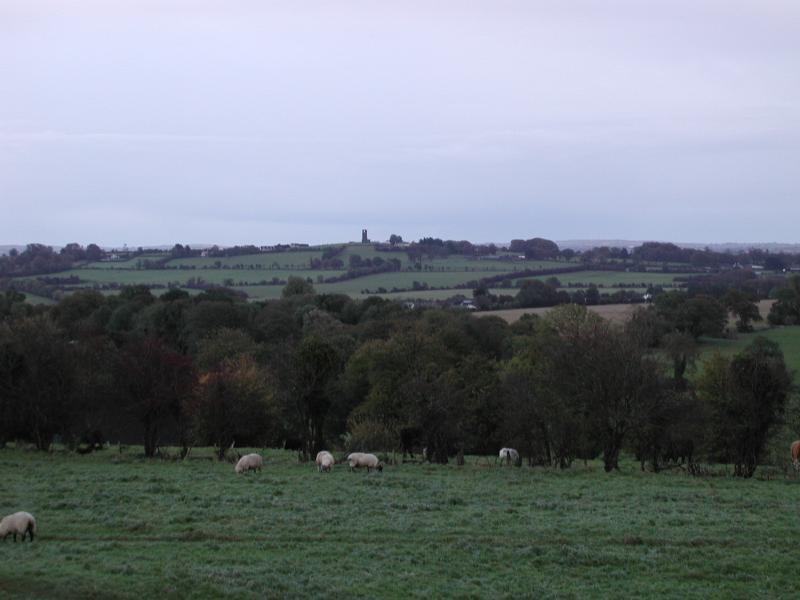
We decided to go the the Hill of Tara, even though we wouldn't have much time there before dark. Tara is now a sheep pasture, but for centuries it was the seat of the High Kings of Ireland, and there are many legends about the site. In the pasture are ringwork ditches, mounds, defensive ditches, and other earthworks. We didn't really know much about the site as we wandered up and down its mazes of hills and ditches, but we could feel the power in the place--it was a grey dusk, and the wind roared across the hill. The view of the surrounding area from Tara is imperious (supposedly, you can see half the counties of Ireland from Tara). The Visitors' Centre for Tara, which is housed in St. Patrick's Cathedral on the hill, was closed for the evening, but a sign told us some information about the site--the long row of parallel ditches used to be a massive banqueting hall. St. Patrick fought and won a battle at Tara, helping to spread Christianity. We enjoyed wandering among the sheep and feeling the air about the place. It was hard to leave, but we forced ourselves back into the car.
After that, we set off for our B&B, a large old house with lots of guest rooms and very kind owners who gave us directions into Dublin, where we were planning to eat dinner.
The drive into Dublin was a little longer and more bonkers than we had expected (it was Friday night of a bank holiday weekend, so I think it was a little crazier than usual). We planned to eat in the Temple Bar area, which was packed with people, so we had a lot of trouble finding a parking space, and then it was a trick finding a place for dinner--none of the pubs had food, and the restaurants that were still open (restaurants tend to close pretty early in Ireland) were jam-packed with people. We finally found a nice Italian place and had a nice meal there. We were too tired and hungry by that point to care much about what we ate, but after a good meal we felt much better, and returned to the cobbled streets of Temple Bar to wander and mingle. Temple Bar is near Trinity College, and is the hot place to be on a Friday night. The streets were full of people of all ages and types. A bagpiper played on one street corner, and a juggler played with fire to the accompaniment of a drummer on another. We wandered down a side street and found a kindof dodgy but not-too-packed pub, where Jonathan had a pint and smoked his pipe and we watched the locals. We didn't stay in there very long, but returned to the streets to do some more wandering before we headed home for the night.